
How to Use an AI Code Writer to Refactor Code (Without Breaking It)
Refactoring means reshaping the inside of your code so it is easier to read and cheaper to change — without altering what it does. A modern ai code writer turns that slow, risky chore into fast, reviewable steps: it renames cryptic variables, extracts long functions, removes duplication, and flags code smells while your tests stay green. According to Wikipedia’s entry on code refactoring, the practice dates back decades and predates any AI tooling — the discipline hasn’t changed, only the speed at which it can be applied.

This guide shows exactly what an AI coding assistant can refactor, how to keep behavior identical, and a safe step-by-step workflow you can run on real code today.
What «refactoring» actually means (and what it doesn’t)
Refactoring is a change to the internal structure of software that makes it easier to understand and cheaper to modify without changing its observable behavior. That is essentially Martin Fowler’s own definition, and his site refactoring.com remains the reference point for the practice. It is not rewriting, not adding features, and not fixing bugs. Same inputs, same outputs — only the shape changes underneath.
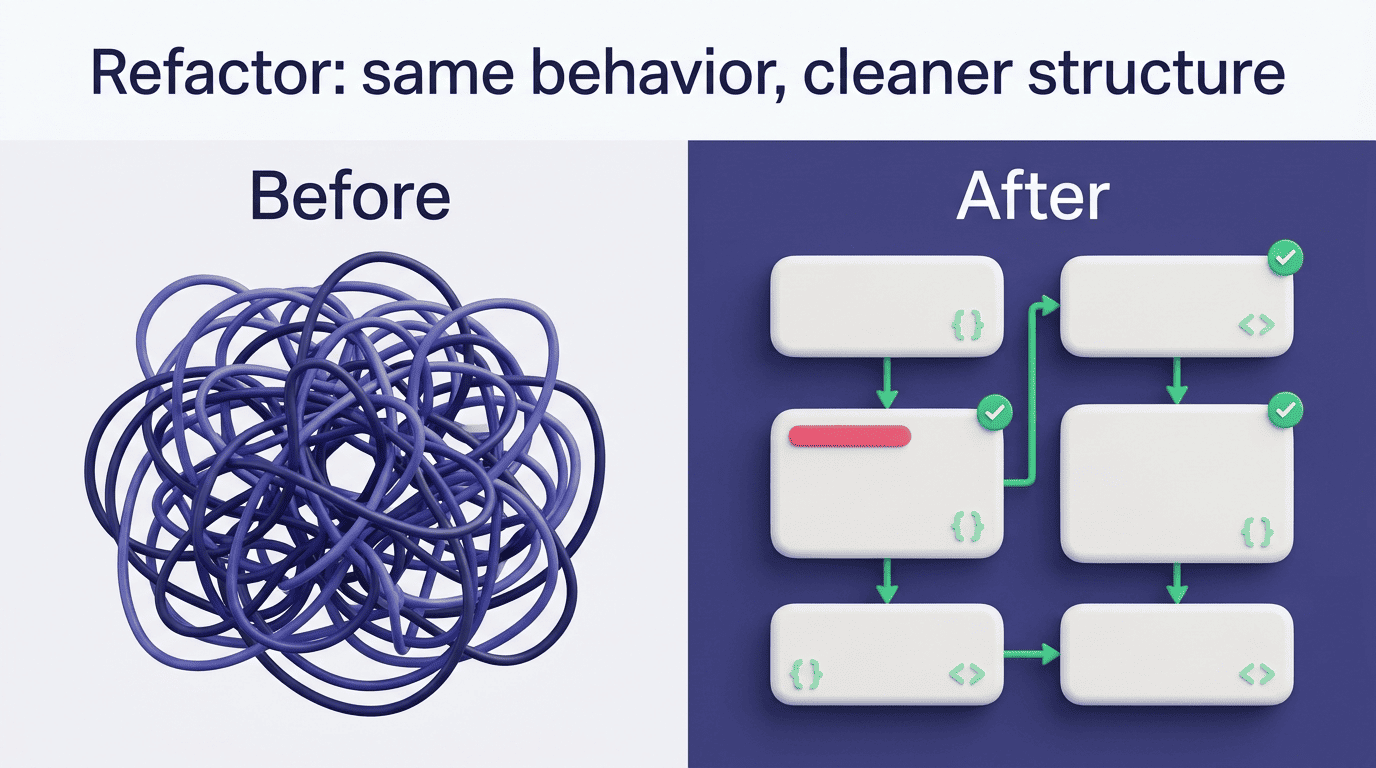
The term itself has a documented origin: it first appeared in print in September 1990, credited to William Opdyke and Ralph Johnson, according to Wikipedia. That matters because it draws a clear line between two very different activities that get confused constantly.
| Refactoring | Rewriting |
|---|---|
| Behavior stays identical | Behavior can shift or break |
| Many small, reversible steps | One large, high-risk change |
| Tests confirm nothing changed | New tests must be written from scratch |
| Existing design is salvageable | Existing design is discarded |
Why it matters
Developers lose an average of 42% of their work week to technical debt and bad code, according to Stripe’s 2018 Developer Coefficient research, and separate industry analyses put the ongoing cost of unpaid technical debt at roughly $300,000 per million lines of code each year. Refactoring is how you pay that debt down incrementally instead of gambling on a risky big-bang rewrite.
- Smaller pull requests are easier for teammates to review.
- Behavior-preserving changes are far less likely to introduce production incidents.
- Incremental cleanup compounds — each pass makes the next one cheaper.
- Technical debt left unpaid slows every future feature built on top of it.
What an AI code writer can refactor
An AI coding assistant applies the same catalog of refactorings a senior engineer would, just faster and across more files at once. Here are the core moves it handles well.
Rename for clarity. Turning d, tmp, or data2 into intention-revealing names is the cheapest readability win available, and an AI code writer will do it consistently across an entire codebase in one pass rather than file by file.
Extract function and extract class. Breaking a 120-line function into small, single-purpose functions — or moving a cluster of related fields and methods into their own class — is the highest-leverage refactoring for long, tangled routines. This is the move an AI refactoring tool reaches for most often because it directly attacks complexity.
Remove duplication (DRY). Consolidating repeated blocks into one reusable function means a future change happens in one place instead of five scattered copies.
Reduce complexity and dead code. Flattening nested loops and conditionals, applying guard clauses to lower cyclomatic complexity, and deleting unused variables or functions all shrink the surface area a future developer has to reason about. Modern AI-assisted refactoring tools cover a wide language range, among them:
- JavaScript and TypeScript
- Python and Java
- C#, C++, and Go
- Rust, Ruby, and PHP
Apply design patterns. Where a genuine anti-pattern or sprawling type-check chain exists, an AI code writer can propose polymorphism or a fitting design pattern — but only where it actually simplifies things, not for its own sake.
Consistent naming conventions matter here too. Python’s official style guide puts it plainly:
Code is read much more often than it is written.
PEP 8 — Style Guide for Python Code
That principle isn’t Python-specific — it’s the underlying reason nearly every refactoring on this list exists: code is written once and read dozens of times afterward, so structure and naming pay for themselves repeatedly.
How to keep behavior identical: tests stay green
The golden rule is simple: automated unit tests must exist before you refactor, and they must still pass after — that is your proof behavior was preserved. Fowler’s own discipline calls for small, behavior-preserving transformations, with the system kept fully working after every single step, rather than large speculative changes made all at once.
In practice, that means asking the AI code writer to run or write the missing tests first, refactor in small commits, and re-run the full suite between each step. If a test goes red, the last small change is almost always the culprit — revert it and retry with a narrower scope rather than debugging a large diff.
| Signal | What it means |
|---|---|
| All tests green before refactor | Safe to proceed |
| Test goes red after a small step | Revert that step, not the whole session |
| No tests exist yet | Generate tests first, refactor second |
| Large diff, several files touched | Scope is too big — break it down |
Code smells an AI code writer flags
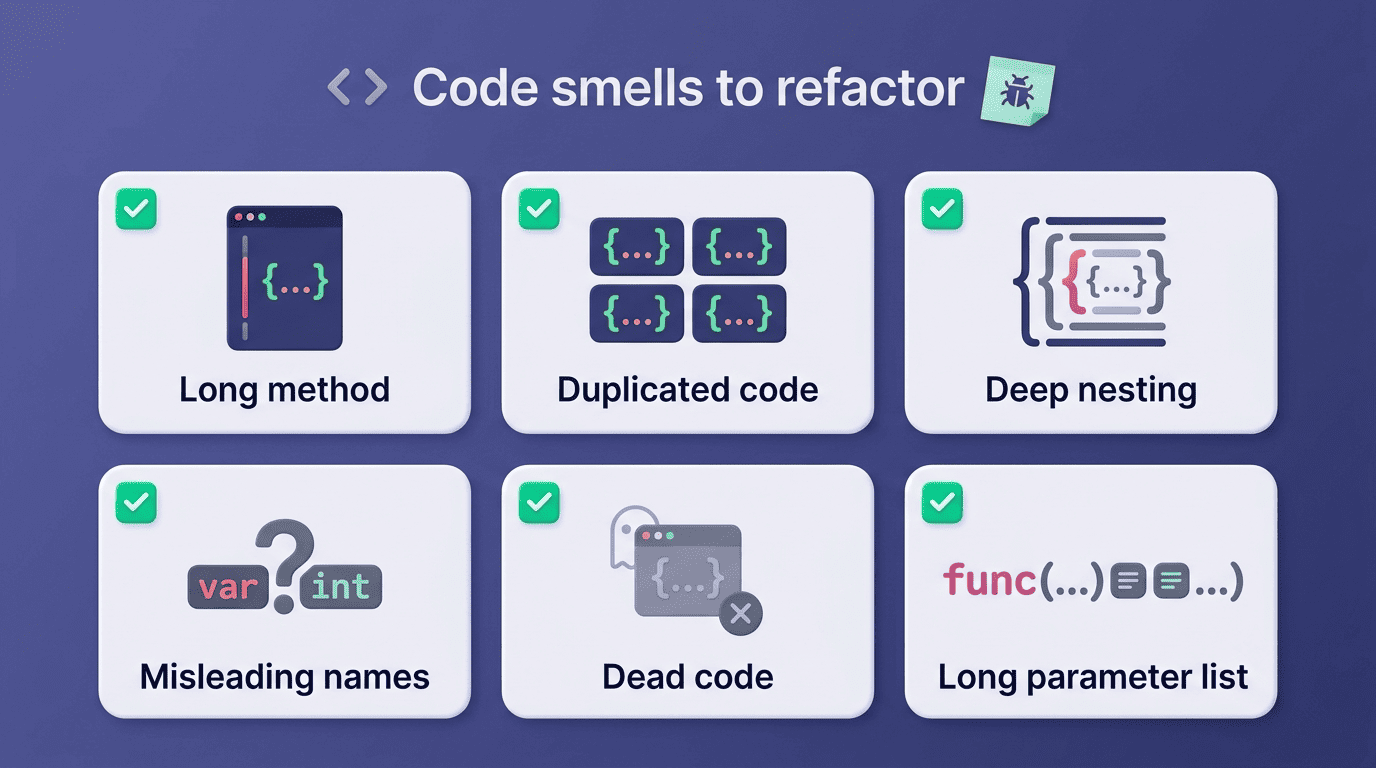
Refactoring is usually triggered by a code smell — a surface signal of a deeper structural problem, not a bug in itself. Common smells an AI coding assistant will surface during a scan include:
- Long method — a function that has grown far beyond one clear responsibility.
- Large class — a class that has accumulated unrelated fields and methods over time.
- Duplicated code — the same logic copy-pasted in multiple places.
- Long parameter list — a function signature that has become hard to call correctly.
- Misleading names — variables or functions whose names no longer describe what they do.
- Deep nesting — loops and conditionals stacked several levels deep.
- Feature envy — a method that relies more on another class’s data than its own.
The smell itself isn’t the problem; it’s a hint that structure should improve before the next feature lands on top of it.
A safe step-by-step workflow with an AI code writer
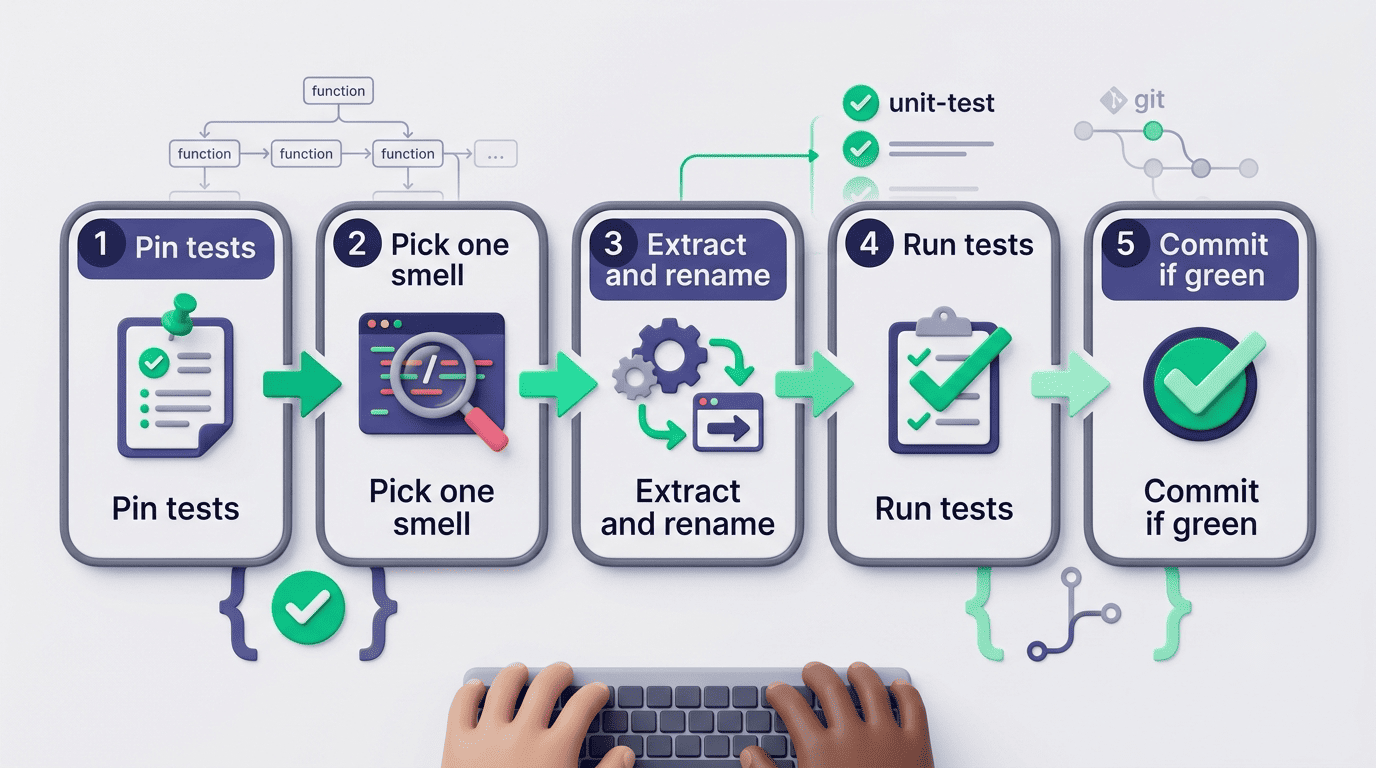
- Pin behavior: make sure a passing test suite exists, asking the AI to generate any missing tests first.
- Pick one smell — one function, one duplicated block — and keep the scope small.
- Ask for a named refactoring, such as «extract function» or «rename for clarity,» rather than an open-ended «rewrite this.»
- Review the diff line by line — you own the change, the AI only proposes it.
- Run the test suite; commit if everything stays green, revert if anything turns red.
- Repeat on the next smell, and never mix refactoring with feature changes in the same commit.
Limits and risks (keep a human in the loop)
An AI code writer can misread intent, «fix» behavior a downstream system quietly relied on, or over-engineer a solution with design patterns the code didn’t actually need. Common failure modes worth watching for:
- Renaming a variable whose name is load-bearing for an external API or serialized format.
- Removing «dead» code that is actually reached through reflection or dynamic dispatch.
- Introducing a design pattern that adds indirection without reducing complexity.
- Refactoring across a boundary that has no test coverage at all.
Treat every suggestion as a proposal rather than a finished change: review each diff, keep the test suite as the real safety net, and refactor in small, reviewable steps rather than one sweeping pass.
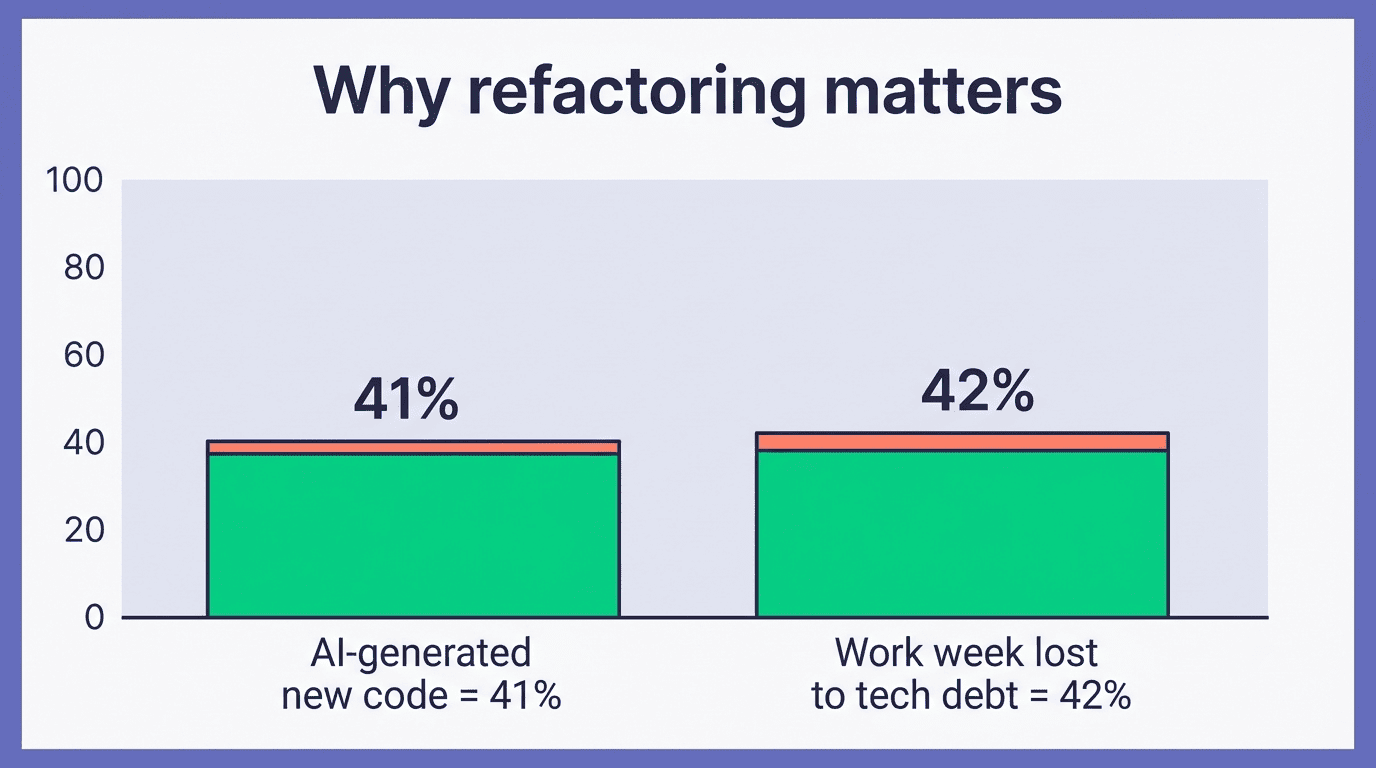
AI now generates roughly 41% of new code being written, according to SecondTalent’s analysis — which makes disciplined, test-backed refactoring more important going forward, not less. As more code is machine-generated, the habits that keep it maintainable (clear names, small functions, low duplication) matter even more.